
- cross-posted to:
- world@quokk.au
- world@quokk.au
- health@lemmy.world

- cross-posted to:
- world@quokk.au
- world@quokk.au
- health@lemmy.world
Weight-loss jabs such as Wegovy could be made for just $3 a month, according to new analysis, potentially making the treatment available to millions in poorer countries as patents expire.
More than a billion people live with obesity worldwide, with rates rising fast in lower-income nations as they shift to westernised diets and more sedentary lifestyles.
The World Health Organization designated semaglutide – sold to treat obesity under the brand name Wegovy, and diabetes under the brand name Ozempic – as an essential medicine in September last year.
But global health leaders warned at the time that high prices were limiting access.
New research, published as a pre-print, suggests that semaglutide could be mass produced for $3 (about £2.35) for a monthly dose in its injectable form.
You must log in or # to comment.
Now if we only stopped thinking that willpower is some magical fairy dust we were all granted when we turned 18 and not using it “correctly” indicates moral failure.
For real, this just boggles my mind. All this neuroscience, psychology, biology and so many still somehow believe in some vague magical essence that is totally independent of any biological or environmental factors.
It’s not a willpower problem, it’s a processed food problem. Depending on something wishy washy like “willpower” to a very predictable cause and effect is a very dumb approach to public health
It’s like relying on enlightened self interest to distribute vaccines
That’s my point. Willpower (independent of biology+environment) isn’t a thing to begin with.
I’ll go one further, if we had sufficient understanding of how biology and consciousness worked, I believe we would not be able to construct an argument for the existence agency or free will.
Ohh yay, thank you for prompting me! The thing is, even as things are now, there is no logically coherent argument for free will (that doesn’t require re-defining absolute free will to accommodate people who just really like the idea of free will). Digging deeper into biology, consciousness, neurology etc. consistently fails to find a mechanism for uncaused agency.
You literally don’t choose the next thought you have. You’ll have already thought it by the time you know what it was. This includes non-verbal thoughts, vibes, your feelings about matters. By the time you cognize any of them, they’ll have already happened. You can deliberate but you don’t choose if you do, you’ll only know after the fact if you did. This is just… plain as day once you are willing to face it.
Belief in free will is just a stubborn thing we have because A: we really just LIKE to think that we have it, and B: Christianity(/Abrahamic religions), in which western thought is rooted, specifically demands the existence of free will. Anyone’s belief in free will is just the result of not having one; they’ve been exposed to a lot of reinforcement of the belief so they take that as a fact.
Further, not having free will carries two implications that people really, really don’t like:
-
If people don’t have free will, they aren’t at “fault” for their “bad” behavior. People much prefer to be able to simply judge, rather than consider nuance. On this topic, it’s easier to say “fat people are just lazy gluttons”, instead of accounting for various mental health situations and environmental factors (upbringing, culture etc.). People who grew up with unhealthy habits often struggle to change them if that’s all they learned, and the body really likes to hang on to fat once it gets some. This often makes losing weight significantly harder than maintaining a healthy weight. That’s just some of the nuance for the topic, and there’s way more. Thinking about all that takes a measure of cognitive bandwidth which not everyone has so it’s simply more efficient to jump to a judgment (but as I see it, if they don’t have the bandwidth, it would be more intellectually honest if they didn’t weigh in on the matter at all). Plus getting to judge someone inherently puts one in a superior position in one’s own mind, which gets to the next point:
-
If people don’t have free will, any personal achievement anyone is proud of is just the result of “randomness”(except there’s no reason to think there’s true randomness in reality, any more than there is in computer RNG, it’s just complicated to the point that the concept of “random” remains useful in everyday language). They lose the superior position. This is often more significant to people than the much more positive implication that there is nothing inherently wrong with anyone (so people beating themselves up for all their perceived shortcomings are off the hook - however much they think they suck, the fact is that they are the perfectly natural, normal and expectable result of everything that ever was).
It’s a direct challenge to our moral intuitions and again, because people like to go for simplicity, they confuse trying to understand causes as excusing behavior. Which it isn’t. You don’t have to have free will to have consequences for undesirable behavior. But you can impose the consequences from an informed place that actually aims to reduce the undesired behavior. But we tend to prefer “eye for an eye” thinking, again because it’s simple and it caters to our base desires.
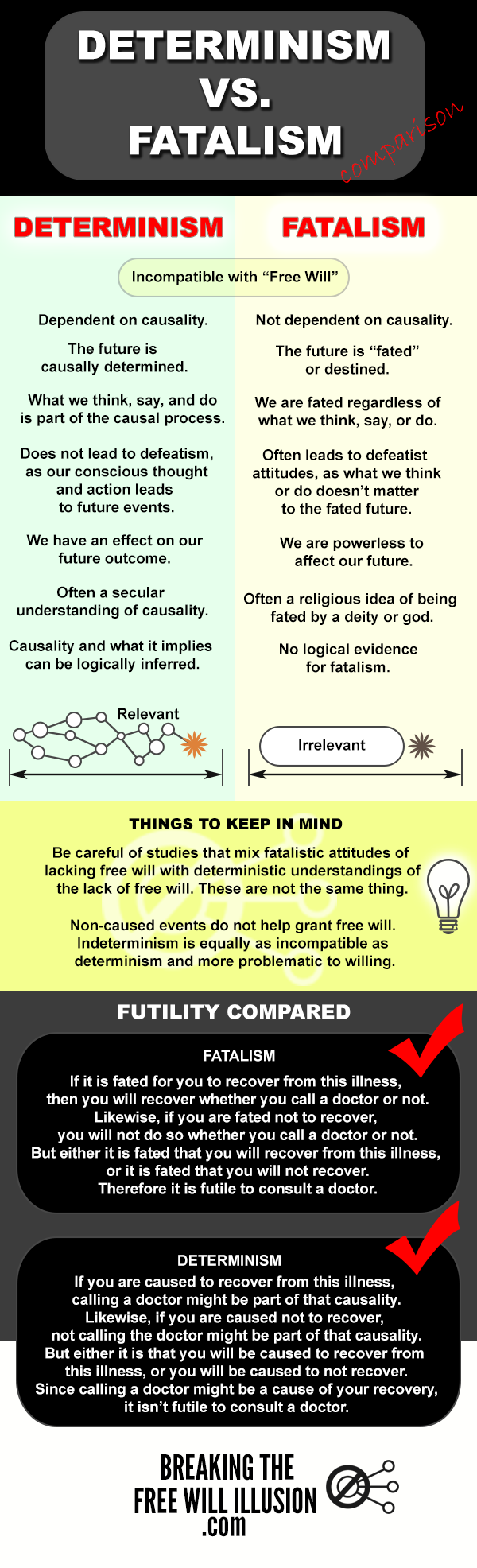
Add to this that people frequently confuse lack of free will (determinism) with fatalism ( https://breakingthefreewillillusion.com/wp-content/uploads/DETERMINISM-VS-FATALISM-infographic.png ), which leads to people arguing for free will because they think that the lack of it makes “trying to change things” pointless. Which is not an argument for free will, that’s just a problem in one’s understanding of the topic ( also https://en.wikipedia.org/wiki/Appeal_to_consequences ).
Lovely reply, friend!
I have a semi-bullshit theory that free-will if it does exist arises from some sort of quantum action inside the brain that we cannot fully understand or possibly even consciousness is some sort of funky quantum shit that goes on that we don’t understand yet.
I came up with this idea for the 15 minutes that I actually understood how quantum mechanics worked, and I can’t explain it to you now, so I apologize.
-
I’m not sure how I think and feel about the drug. I’m very happy for people that can get a handle on their bodies and diets. That is really pleasing. Even people I don’t like when I see them losing mass as a result of its use I’m happy for them as individuals.
But it makes me think of it is as at type of recreational drug use. And that moral quandary of quantifying when drug use is transgressive and when it is not when the goal is chemically altered happiness.
But it makes me think of it is as at type of recreational drug use. And that moral quandary of quantifying when drug use is transgressive and when it is not when the goal is chemically altered happiness.
I think this is a good point. For many people who take it, the goal is not to address a physical health concern (those people can address it through exercise which they still need while taking these medications), but to make themselves happy by making it easier to lose weight that they believe is excess.
Now I’m of the opinion that their self-image being so negative is more of a mental health problem (and I’m specifically not referring to people who are extremely obese, diabetic, etc here), but regardless, it’s not my place to prescribe them a treatment for their own issues. If these medications make them happy, then whatever.
The issue we have today is an issue of scarcity. Ozempic is expensive as fuck and isn’t accessible to the people who need it. For example, my sister in law is morbidly obese and has physical and genetic disorders that lead to a drug like this being lifesaving to her. She can’t really afford it even with insurance, but it’s not really a choice.
One thing to keep in mind though is side effects. These drugs aren’t all sunshine and rainbows. There are risks associated with them. For people who need them, the benefits usually outweigh the risks, but for “recreational” use, those risks should naturally be taken into consideration by whoever’s taking the drug.
I don’t see it as “recreational” because it has a quantifiable benefit to physical health.
recreational drug use
and what is the problem with that?
Man the corporate agro-industrial complex must be so excited about how the corporate pharmaceutical complex is pioneering for a humanity with limitless tolerance to fat and sugar. The shareholders will be delighted!
This drug does the opposite. It reduces appetites so people eat less.
Uhmmm … that’s not how it works. It halts your fat and sugar absorbtion … “tolerance” is not the word I would use to describe getting the screaming shits after eating too much fat and sugar.
The main feature is the appetite suppression … that is VERY real.