I mean, if you aren’t counting your calories and eating in a deficit, you’re not going to lose weight.
Research shows that small amounts of physical fitness during the day can be just as beneficial as a full workout
A 2019 review of 19 studies looked at this question, involving more than 1,000 participants. It found multiple, shorter “chunks” of exercise in a day improved heart and lung fitness and blood pressure as much as doing one longer session.
And there was some evidence these chunks actually led to more weight loss and lower cholesterol.
honestly, makes sense. a lot of people don’t want to dedicate a whole chunk of time out of their busy lives, but it’s easy to squeeze in a set of squats or something between tasks
just as beneficial as a full workout
So if a full workout doesn’t do much for losing weight, these small amounts of physical fitness can be “just as beneficial”?
That’s not saying much hah.
Exercise is for muscle strength and endurance, mostly. Eating is for weight loss or gain.
So it depends on your goal.
has nothing to do with eating a deficit in calories. you can workout all day everyday, but if you eat garbage mcdonalds and packaged food, you are not going to lose weight ‘micro working out’ or even full day workouts.
The quality of food has little impact on weight loss. It’s calories in calories out. Period.
Eh. Calories are… Tricky. What is a calorie? A unit of food which, when burned, will heat a gram of water by 1 degree Celsius. But your body isnt just a furnace, it’s complex. And everyone is physiologically different - we aren’t all running at the same efficiency (base metabolism). And not all calories are available. For example, fiber is not digestable and can’t be absorbed by the digestive system and it also associates with simple sugars which also prevents them from being properly absorbed. So, eating whole fruits will result in absorbing less sugar than drinking juice which has the same total amount of sugar. Processing food - even just cooking it - makes calories more bioavailable.
For sure it can conceptually be boiled down to calories effectively absorbed and calories burned. But digging into what that actually means can actually be quite tricky.
You’re making it sound trickier than it is. Nutrition data on all foods will already discount fiber from the calorie counts.
But in a sense you’re also not wrong, that while calories are king when it comes to weight loss/gain, there are complications for that. For example if you give two different people the exact same food in the exact same amount of calories, they will gain or lose weight at different rates - highlighting the role of genetics. Another genetic factor related to calories only indirectly is how some people have much higher impulses to eat than others, making calories only a part of the story for their challenges with weight loss. I’ve also seen a headline for a study claiming that an amount of dairy caused more weight gain than the same amount of calories of peanut butter, though you may want to take that one with a grain of salt unless you actually see the study.
Personally I’m not a fan of measuring calories. Instead I use base knowledge to have ways to intuit calories more naturally. For example, I know that carbs and protein are 4 calories per gram, and fat is 9 calories per gram, making fat almost always the quickest way to make foods significantly more calorie dense. Other things can be very calorie dense too though, like sugary or other caloric beverages. Replacing those with water, coffee, or teas can be enough on its own for some people to start losing weight.
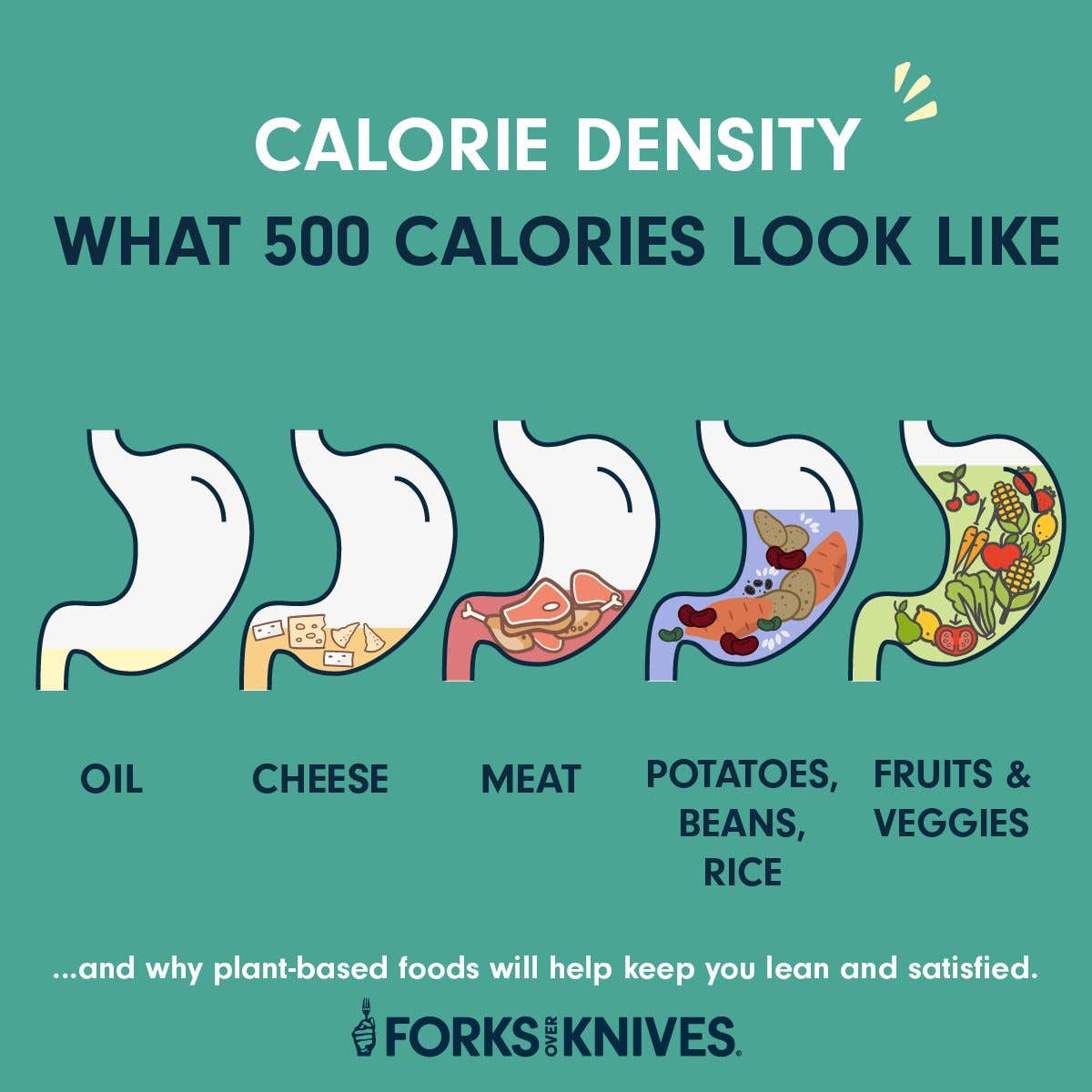
Some foods are more dense than others. Being that leafy greens and many other vegetables are naturally some of the least caloric foods you can eat, loading all of your meals full of them is an elegant way to reduce calorie consumption without needing to starve yourself. It also has the double benefit that high fiber foods are more satiating - they calm food cravings.
Point is, calorie management doesn’t have to be a headache, and it doesn’t mean a person has to starve themself.
I wasn’t talking about fiber, but the sugars bound to fiber. Its very hard to accurately labele just the bioavailable calories, even if you account for things like fiber.
On the note of genetics, it’s not just about metabolism. People have different abilities to even absorb the same calories. People have food intolerances, different rates at which they move food through the digestive tract, and different intestinal permeability.
This isn’t meant as an excuse to eat junk and not pay attention to your food. But, I actually find more help in paying attention to food quality and listening to how your body interacts with different food. E.g., eat less processed food, be aware that eating fat slows digestion, pay attention to your intolerances, stop eating when full, cut out snacking (again, especially processed foods). If you do this, its very likely you won’t need to count at all.
That’s not to say that, if calorie counting works for you, then you shouldn’t do it. Its just not the end all be all people act like it is. Pretty much any diet and paying more attention to what you eat in any way works: https://pubmed.ncbi.nlm.nih.gov/32238384/
Yeah those are pretty useful common sense approaches.
None of that actually matters when it comes to weight control. What matters is that the linear relationship is retained in your proxy measure of Calories. Meaning that if you eat two pieces of cake, you’ve doubled your Calorie intake compared to eating one piece.
Ok but my point is you’re not just eating cake so its hard to keep track of the linear relationship sometimes. Calorie reporting can be incorrect and bodies are weird. That’s all I’m saying.
Realistically, being on most any diet is equally effective. From simple calorie counting to the keto diet. It turns out that, if you find a diet you can stick to, then just kind of paying attention to what you’re eating in a general sense works.
An example with an oversimplified diet to illustrate the point I think you’re trying to make: You have a diet that’s exclusively cake and you’ve determined that you need 2000 Calories of cake to maintain your weight. That 2000 Calories figure is an estimate and we don’t know exactly how much of it we’re actually absorbing. In reality, it’s actually more like 1800 Calories. Now all of a sudden, you switch your diet to eating exclusively cookies. You measure out exactly 2000 Calories of cookies and eat the same thing every day. But your Calorie estimate is wrong and you’re actually eating 2100 Calories of cookies per day. Now you gain weight on this supposed 2000 Calorie diet.
I argue that this doesn’t matter either. If you see that you’re gaining weight, then it means you’re eating too much. Reduce your Calorie target and you’ll be back on track. In a real world scenario, you’re going to have a much more varied diet than only cake or only cookies, and each item will come with their own measurement errors. But for most people, their diets are varied in a fairly consistent way, so these errors are also consistent on average. If you ever make changes in your diet (e.g. completely cut out McDonald’s), you’ll change both your estimated Calorie intake and target like in the example above. Adjust your numbers accordingly based on how your bodyweight moves and you’re good.
Of course, other ways of dieting are also effective. It depends mostly on what you can adhere to and your goals.
If you get 0 calories what happens?
I was trying to count calories for my soup, some ingredients had calories on the package, but vegies and meat didn’t, so I went to online calculators. None of them were capable of measuring ingredients in grams - I have kitchen scales so can easily weight raw ingredients and put them in the calorie calculator, but all of them measure food in servings instead of concrete number, like what is one serving of my soup? And are the calories for raw ingredient going to be the same after being cooked? The only way to measure calories is to dehydrate it, burn in a special chamber and count the ammount of excluded energy. You can find people onlain making claims like “I’ve eaten 2017 kcals today”, but like how did you measure that 17 kcals with such a precision? The measurements I got from online calculators gave me a 500 kcal range of error, as in a serving of my soup could be 400 kcals or 900 kcal and again those are just estimates made from combining known calories of raw ingredients. Calories are for scientists and experiments, without equipment you can’t actually calculate the calories, just like you can’t really measure how many calories did you burn during the workout, again the range of error is huge, it’s good to keep in mind the calories in calories out idea, but actually measuring them is not for the 99% of thr population
Calorie counts on food are an approximation, sure, but it’s not unreliable. If someone eats roughly X amounts of calories every day and they lose/gain weight at Y rate, then the exact amount isn’t as important.
It’s weird that it works for most people.
Yeah, exactly, calories in vs calories out is just another myth that feeds the diet industry’s bottom line. It’s not accurate. Like bmi used to be the big thing, but that’s not an accurate measurement system at all.
Calories in calories out is literally just the laws of thermodynamics and conservation of energy. It’s a fact.
Where it gets tricky is that the actual equation has quite a lot of variables.
You could, for example, increase your passive energy requirements with this micro dose of exercise situation. Does it raise your body temp (or rather the demands to maintain it at homeostasis) for a longer period of time and thus increase calories demanded that way?
Or, like a lot of fitness studies, it’s fucking junk because it trusts self reported calorie intakes.
I get where you’re going, a human body isn’t quite comparable to those factors though, it’s a bit more complex than that, because what you’re trying to do is kick in a chemical reaction to release hormones to signal to your fat cells to release them, and that they no longer need to be stored.
In that premise you need to look at why your body stores fat, and in what mechanisms it releases them.
Fat is seen by the body as more of a battery, to save itself (you) if shortages should occur, which is kinda where the calories in vs calories out come from. Right, but, that’s a temporary, survival mechanism that you’re trying to kick in there, and when you tell your body you don’t need to be in survival mechanism mode, any more, it goes, “oh, look, we’re resting, that fat that I stored saved us, I need to save more”
You can’t continually operate in a calorie deficit, and exercising more than you intake. It’s not sustainable long term. Your body will try and bounce back to it’s “normal”.
Calories in and of themselves don’t have one static notion or rule, summing up all things edible to calories is entirely deceptive, in and of itself. Food offers different nutrients, and your body is really good at making the essential nutrients it needs, out of chemical reactions, from whatever you put in, other than some essential amino acids, which is can’t make on its own. But also, different foods do different things to your digestive system on the way through.
Calling all food calories, and trying to reduce it to a same action product, in the first part of the equation (calories in) is like saying anything with computing powers, is the same and can and does the same actions, but you can’t send emails with your alarm clock.
Different foods offer different energy output and productions in the body. You won’t get the same energy levels from fibre that you do from protein. So summing up all food into one label like that, ignores so many chemical factors that occur in the body when you digest food, and how different foods operate in said meat machine.
Not all calories are equal, so the premise is inaccurate, in that summation.
Calories out, similarly ignores huge wafts of data, chemical reactions, hormone functions, metabolic rates, genetics, gender (it has only ever been a model tested, if you can call it that, on males), age, and more. It, also similarly ignores the base systems of the body, and why it stores fat, what happens if you release fat in the wrong way, and the rubber band effect, that causes. I could go into so much detail about that part, but I’m already waffling.
I don’t know if thermodynamics matches how a human body sets off a chain reaction to release fat cells, but if I were to relate it to energy, which thermodynamics is a form of. Because we’re talking about a very complex system of chemical reactions. It’s a way too simplistic thing to relate it to, because the human body has so many hormones that all combined do so many different coded locks and key processes in the body. Adrenalin is a hormone, dopamine is a hormone, even histamine (allergy reactions) are hormones. And they all signal different actions to and within different cells of the body.
Whereas energy, in physics is a very simplistic thing that reacts the same every time, in so much as that they have equations that math it out, every time. You can calculate the energy loss, resistance, voltage, amps etc, and they’re the same, because it’s one form, not a complex system, which a human body is. It’s also not going to equate to the same calculable set of parameters in every human body, like you can with energy. Energy is “a” being equal to “c” divided by “b”, and it will always be the same. Every human body absorbs and processes different nutrient intake differently.
But imagine if you told everyone, instead, to find a long term comfortable sustainable diet rich with variety of fruits, vegetables, legumes and beans, nuts, meats. Less, ideally no, processed foods or junk foods, and just moved their body frequently and regularly, nothing big, just something. Minimally. (that not being the entirety of it) how many businesses and whole bodies of corporations does that message, put out of business?
This is untrue. Calories in vs calories out continues to be, and will always be the center point of weight loss. It’s just complicated by other factors like genetics, finding each individual calorie needs, and following diet and lifestyle patterns that are effective and sustainable.
See but I think we’re both actually saying the same thing. The amount of factors that go into calories in vs calories out, essentially makes it unusable. Just looking at calories as a base whole product, not the individual piece of food and the nutrients it provides, is mad. By that rationale you could just live on oranges. They’re calories, or junk food. Calories.
It’s not calculable, how one individual body absorbs, processes, and then manufactures the essential nutrients it needs, from “calories”. It’s essentially saying how much food in vs how much food burning out. But that’s not how fat is turned from fat to energy consumption, by the human body. It has nothing about the essential needs of the body.
It’s a myth perpetuated by diet industry that only keeps you on the hamster wheel of weight loss and, for most people not genetically gifted, never really works. Or only works short term but then your body goes into survival mode, and stacks it all, and more, back on.
Here’s a an article that might help say things better than I am. https://www.sydney.edu.au/news-opinion/news/2023/07/05/its-time-to-bust-the-calories-in-calories-out-weight-loss-myth.html
question, you point out the diet industry, but how do you feel about the fast food industry purposely making their food addictive just to make a profit, health be damned?
Predatory af, right! Similarly as predatory. There’s 18 ingredients in maccas chips. Wtf.
Dunning Kruger.
Your body is so much more complicated than a function that takes calories as input and outputs an expected result. You need more than just calories, you need nutrients. A nutrient deficient person does not burn calories the same way a person with a balanced diet does.
Like just think for a second. Is the only variable of food that matters is calories, then why do you need vitamins? Why do we split calories into categories like protein, carbs, veggies, fruits, etc? Why can you get a PhD in nutrition if it’s only as simple as calories in calories out?
The simple answer is it’s not simple. Asserting that it is when it isn’t creates some terrible narratives around exercise, diet, and body image.
Ok, bud.
Guys, eat nothing but vitamins!
You are not making sense. If I’m a football player and use 3000 calories a day working out, I will lose weight. When you’re counting calories, do you put the exercise factor in?
Yes, calories matter, but working out is usually part of it. This is because it burns calories at the time, but continues to speed up your metabolism.
Our bodies are meant to move, plus counting calories is a defeating process. I’m not saying eat crap, but try to eat healthier and move your ass.
Most people severely overestimate the amount of calories they burn working out and eat more than they need to as a result. Working out is important for health, yeah, but losing weight is best done by changing your diet
Tell this to the guy who ate nothing but McDonald’s for a month and lost 60 pounds (26kg)
Kevin Maginnis
LOL, I’m 5’2" and hover around 100 lbs, and I’ve had trouble gaining weight my whole life. Eating more doesn’t seem to help much. But I have noticed the more I eat, the more I shit. Perhaps that’s where all my calories are going 😭 .
the more I shit
I mean that’s still ‘calories out’ if you’re not actually absorbing them. Guessing you’ve already done this if it’s been a life long thing, but just in case, you might want to hit up a gastrointestinal doctor - there are conditions that cause usable nutrients to literally just go through you. You may have one of those - and if yes, knowing which will give you a path to fixing it or working around it.
Then again, 5’2 at 100 lb is only just a hair into the underweight range. If you feel good where you’re at, maybe fuck it.
Thanks! I’ve been to a few doctors over the years, and they didn’t find any specific diagnosis. It was really a problem during my adolescence, at first delayed, then bang-o (and then I had all kinds of other things to worry about). Now that I’m past all that things have settled down, and my doc says I’m doing well. This is just my normal, he says.
Fair enough! Keep this in the back of your head though if you ever become critically injured or sick - daily caloric requirement goes up when you’re recovering from something, so yours specifically might be even higher than that already-higher-normal.
There comes a point where eating anything just feels gross cuz you’re already stuffed, so you’d have to start being strategic about meal/snack timing, and prioritizing high calorie foods and drinks. Hopefully your team would have access to your history in that situation, and account for that shit from square one, but YOU are your best advocate, so don’t be afraid to prod them if needed.
…and sorry lol, been doing a fuck ton of nursing school homework the past few weeks, so my brain is still in nurse mode when I hop on Lemmy. You’re basically an NCLEX question! :P
No worries! And you’re going to be an awesome nurse 💯 👍🏼!
It’s all genetics. Some people gain a lot of weight easily, some eat as much as they can but still lose weight.
I’m 5’7 and 130lbs. It took me 3 years to gain 30lbs. Gaining more is legitimately impossible. There simply isn’t enough time in a day to eat enough calories, unless I do nothing else.
I am 5’9", was 125lb, bulked at the request of my husband, wanted to get to 135 but ended up at 150. I’m sure my proportions are more conventionally attractive now but it does a number on my self image, I was so attached to being thin. Guess what though…
I feel better at this weight physically, if not mentally. Everything works, nothing hurts. I feel so silly complaining about being at a medium weight but it is more than I have ever weighed when not pregnant and it fucks with me.
Having got here, it seems to want to stick, but I’m 57, that was not true for me before my 50s and I guess I’m glad I gamed the system by starting out underweight?
I thought research said it is mostly how much you get calories and how much you spent, with genetics playing a smaller role
True, but consuming the calories isn’t as easy for everyone.
I would have thought that too… But I recently saw a youtube video about how we lose weight mostly through our breath! So maybe you’re breathing too much?
Yup, I was doing keto for over a year to lose weight. Got to a healthy weight, stayed there for 3 months, and decided I wanted to gain weight to help build muscle. Put on 20 pounds while still being on keto. Then lost weight again to look leaner. It’s all calories in, calories out. However some people find certain diet types to be easier and preferable to others.
Pretty sure this guy can’t even count.
Eating in a deficit? Yes, counting calories? No. There’s times I lose weight just because of activity load. Hell I did a 3 hour bike ride on Sunday that burned around 2000 calories. When ski touring season hits I’ll probably lose a bunch of weight. I get that most folks can’t do activities like that, but there’s a lot more to fitness than just your body fat. If I loose weight due to exercise it’s usually 10 lbs but over the summer I went from 180 to 165 without thinking once about my calorie intake.
The joy of youth.
Trying to stay young forever over here. It’s working pretty well.
Yeah, you’re definitely an outlier in this lol. Most people who need to lose weight cannot (or, realistic, don’t want to) exercise enough to create a deficit without also changing their diet. You sound like you’re already at a healthy weight and have an appetite that makes it easy to maintain, which is fucking awesome, but a lot of people have too much of an appetite to lose weight strictly by working out.
I mention it because I really don’t feel like an outlier. Sure it took me a couple years to get where I am, but I’ve also had a lot of setbacks from when I started as well. Obviously someone 250-300lbs is going to have a hard time since exercise is murder on their joints. but most folks aren’t morbidly obese. If you enjoy it, getting up to 5 days a week of cardio won’t take that long (3-5 months?) then you can really get into the fun long workouts. But I think the problem is that most folks don’t have something they enjoy. If exercise wasn’t playing I’m not sure I would do it, but because it is I want to do it. If anything my enjoyment and not having debilitating injuries is what makes me an outlier.
Not fat, ideal body form, I’d even say: superior
a seal abs and muscles were built, because they swim all the time. they can hold thier breath for 30minutes, i think some others can hold longer. the southern elephant seal holds the record at 2hours.
another fun fact is when seals/sea lions deep dive they it automatically shuts down thier digestive system. also seals can survive on thier blubbler and fat for quite a long time too. they have mechanisms that allow them to extact alot of oxygen into thier tissues, blood.
seals are quite fast in the water, seal lions even faster. seals do have trouble on land, as the have to act like a caterpillar, while sea lions can walk and run/
It really is what peak performance looks like
I choose to imagine you’re the polar bear version of jason statham’s character in every movie he’s ever done.
southern elephant seal holds the record at 2hours
Don’t want to think how the scientists made them compete for this record
probably a tracking collar, so it can determine how long they stayed underwater hunting squid.
Are we drunk or just 8 years old?
Wow. I thought only redditors were this insecure about their own intelligence.
I thought this was interesting, TLDW is that exercising in cold (water/environment) increases appetite after, so it’s not great for a person that’s trying to lose weight
I’ll fall back on my default null hypotheses here.
- The effect is probably minimal if it exists at all.
- If there is any effect, it is probably negligible if you are doing the big things right.
- Your body is smart, and responds to changes in its environment with an eye towards improved survival and fitness. It is not a simple CICO machine.
So suppose we have an overweight person who is trying to lose weight. They hear about cold water exposure, and how being cold burns more calories. So they start running 10 miles every day at 5 am wearing nothing but a t shirt and shorts in the middle of winter. Then they go to starbucks, buy some hfcs with a touch of coffee, and go work at their office job that they hate because capitalism or something. Almost certainly, this person’s jounts would start to give out quite quickly, but let’s say they hate themselves enough to keep at it all winter. At the end of winter, I would be unsurprised if they gained weight. Sure, they exercised in the cold - but more importantly they were over training, consuming a poor diet, and living an otherwise stressful life. One of the body’s best defences against coming hard times is to store calories for future use - by increasing appetite, decreasing subconscious calorie burning, and shunting resources towards fat storage rather than, say, growth and maintenance of muscle, skin, hair, etc.
On the other hand, suppose we have the same individual. They start with the premise that their body is already great, but they would like it to be better, and the way they will achieve this is via having fun and living well. Thus, their fat loss program consists of learning how to ice skate at the town park after work, going snowshoing on the weekends with their local hiking group, adopting a journalling routine before bedtime, and frequently inviting friends over for dinner parties where they make sure the emphasis of the meal is on protein and vegetables. They also open up to friends about how they aren’t really motivated in their job, and their network of friends helps them gain the skills and industry contacts necessary to get a job that is more to their liking where they get to do interesting and meaningful work with other people whose company they enjoy. At the end of the winter, I would expect this individual to have lost fat despite exercising in the cold. While fat is good for energy storage and insulation, hiking and ice skating are activities where the body generally benefits from having a lower bodyweight - and warmth can be achieved via increased muscle activation rather than fat insulation. Meanwhile, they were spending a lot of time in beautiful natural environments, interacting with people they liked, eating healthy food, sleeping well, and working towards improving their lives in all aspects. “Things are good and I can expect them to get better” is the antithesis of the doom and gloom stress that will likely drive weight gain. Instead, the body will think “the present is not bad, and the future looks easy - and meanwhile, this extra weight is hindering my ability to move easily. May as well get rid of it.”
This is why we find hot people hot. In the past when calories were scarce, a high bodyfat percentage indicated that in the hard times you were living in, this person had access to a lot of calories, and you could expect this trend to continue. These days, life is relatively easy, and storing excess calories is an indication that a person finds life to be hard. A lithe person’s body indicates that they have rarely experienced difficulties beyond their abilities, and that they generally live a happy life. This is a good indication of genetic fitness, and hence, they are hot. Same reason why having good skin, healthy hair, a cheerful and outgoing demeanor, and perky tits are hot - they indicate a prolonged state of positive life circumstances which potential mates could generally count on to continue.
I’ll fall back on my default null hypotheses here.
The effect is probably minimal if it exists at all. If there is any effect, it is probably negligible if you are doing the big things right. Your body is smart, and responds to changes in its environment with an eye towards improved survival and fitness. It is not a simple CICO machine.you could hypothesize and these rambling thought experiments…or you could watch the video, and see there are several studies saying the effect exists and isn’t minimal
that’s muscles!
Muscles don’t keep you warm in freezing ocean water! Blubber does that.
…Man I wish I had a bulletproof excuse like that.
during climate change apocalypse being pudgy is a difference between life and death!
In the hot areas it’ll be death.
such is climate apocalypse
Because the pudgy ones are hunted first?
yup
Seals aren’t humans.
WHAT
I was shocked too.
That’s right, they’re Marines.
So they eat crayons?
Crayolas in, crayolas out
All of the anti-carb diets are a joke. Carbs are fucking great.
They’re really not, but not everyone needs them.
If you’re bordering type 2 diabetes and carbs just make your blood sugar shoot up and crash down, reducing or eliminating carbs can get your shit back in check without medication, and make it much easier to reduce your calories (since you don’t feel compelled to stuff your face again because of shaky hands)
Yeah, they really are. The only valid medical reason to ever use the keto diet is if you have severe epilepsy, and that is an intervention that is only supposed to be done short term, and under close medical supervision.
At best keto as a general diet generally shows to result in rapid weight loss for only about a year at most, before it plateaus. Odds are any results that come from it are only because the person dropped a few high caloric foods. If your plate is usually full of meat and Mac and Cheese, and you replace that with more meat and, I dunno, buttered veggies, then you’re probably eating less calories overall. That would explain the plateau too, because being in a calorie deficit is a state of starvation, and even unconsciously we have a tendency to seek out ways to calm our cravings. That’s why plant-based diets are the most effective and consistent for weight loss, because they are naturally lower in overall calories while also providing foods that are known to be satiating.
Obesity in and of itself is the primary driver of type 2 diabetes, and overconsumption of fats - especially saturated fats - are drivers of insulin resistance. So while keto might provide short term symptom relief since your body doesn’t have to process sugars, it is about the worst thing you could do for yourself to treat the illness, because you are making the underlying cause worse in the long run, as well as driving progression of cardiovascular disease. Effective, sustainable treatment of type 2 diabetes has to involve, first most chiefly, overall weight loss; but you also need to lower total fat intake, as well as replacing the harmful fats like butter, lard, coconut and palm oils, as well as meat and dairy, with good fats like canola and olive oil, and whole food sources of good fats like nuts and seeds, and avocado.
You can find a solid, real scientifically backed program for both type 2 and type 1 diabetes treatment here.
I want it to be understood, I am not interested in internet arguments when it comes to this subject matter. This is not banal identity politics. This is life and death. I have seen too many loved ones die and all from poor lifestyle habits, including type 2 diabetes. It doesn’t need to fucking happen, and I am sick of people flippantly advocating for something that is quite literally the opposite of everything that nutritional science has found to be truly effective. It is grossly irresponsible. Keto is just one more re-branding of a long history of failed anti-carb diets. They never have worked, they never will work, and the only job they need to do is sow enough doubt in people’s minds to get them to keep eating all of the things that are killing them. It is the tobacco industry playbook plain and simple.
I have diabetes and I have this guide to carbs and healthy eating. It’s 45-60g carbs per meal I think, and the portions are hilarious. It’s like 1/100th of a bagel or something.
Checks out, if your bagel weighs more than 4.5-6kg
Sounds about right for average US bagel size.
I’ve never seen a bagel under 20kg so that makes sense.
A regular sized bagel is 60g of carbs, more or less. My dietician had me target 60-75 grams of carbs per meal with a total daily target of 225-245 for my type 2 diagnosis.
That’s a pretty absurd amount of bagel to eat. XD
Here is a really good program for treatment of both type 1 and 2 diabetes. If you follow it you might actually be able to eat a whole bagel.
Carbs/fats/proteins are just the delivery of calories.
If you’re wondering we burn them in the order of protein > carbs > fats. That’s why we store them as fat, eat carbs before an athletic event, and eat protein after one.
If you’re wondering we burn them in the order of protein > carbs > fats.
That’s not true. Learn more about https://en.wikipedia.org/wiki/Citric_acid_cycle if you want to understand.
I’m aware of the basics of macronutrient digestion and metabolism, and your description is… weird. Would you care to share a source on your claims?
It also needs to be noted, unless you’re eating nothing but supplements and highly processed powders, no one eats fat, or carbs, or protein. We eat foods, and virtually all foods contain all three macros in varying ratios. In the real world we get all three together every meal, and if you’re not, it means you’re following a diet that you probably shouldn’t.
no one eats fat, or carbs, or protein. We eat foods
Okay, but pork chops and pasta have very different proportions of the above. You can definitely structure your diet to weight towards one or the other.
In the real world we get all three together every meal, and if you’re not, it means you’re following a diet that you probably shouldn’t.
Angry JBP noises
More seriously, there’s plenty of dumb fad diets, to be sure. And now we’ve got a host of medications for basically shitting out all your calories faster than you can eat them to lose weight. But there’s definitely a problem in our general food delivery system, especially with regards to fats and sugars in fast foods.
Like, you can be blase about food composition. But there’s some shit that simply shouldn’t ever be in your diet (carbonated sodas, heavy preservatives in baked goods, lead). A lot of the “fad” aspects of diets tend to take these fundamentals and extrapolate them out to the extremes.
So you have people running away from freshly made rigatoni because it shares some of the fundamentals with fast food french fries.
And I would take the pasta over the pork chops any day, although they would be whole grain pasta.
I misspoke, it’s not an order as one after another. It’s how fast you digest to get the calories from it.
If you ate something with all 3 you would break it down “in order” because you metabolize one faster.
Water content also plays a role in time.
I mean, I sure do like pizza and beer. But my personal experience is that low carb diets are awesome. I’ve done the keto diet probably about half a dozen times in my life, and (after ensuring my electrolytes stay balanced) it has consistently given me positive results.
I first tried it with the notion that fat and protienn were satiating, and therefore it would be easier to stick to a calorie deficit. Simple. I disregarded all the people who talked about “more mental energy” or whatever bullshit - I just wanted to lose fat. But the results blew me away.
Without counting calories and while eating lots of deliscious food, I lose fat basically without trying and get a six pack. My athletic performance isn’t diminished, and my hunger levels drop noticeably. Hunger itself feels less important, and my emotions in general become more positive - I am more likely to feel happy and grateful and to fall into flow states, and setbacks and bad moods bother me far less. I fall asleep easier and sleep more soundly. My skin looks better. And these effects persist as long as I am on the diet - it isn’t just “losing water weight” or whatever.
Why does it do this? I dunno. Just does. Typically I eat a diet with lots of veggies, beans, some meat, and the occasional pizza and beer night. But comparing a whole foods keto diet to a standard american diet of processed junk food, I’m gonna go ahead and say that keto will come out far ahead, and I’m not gonna let the perfect be the enemy of the good.
Anecdotes are not evidence. Even from your own description it’s untenable to pin down what your diet even is, other than, “whatever you feel like eating.” In that sense it’s virtually indistinguishable from the standard American diet itself. Here is an actual nutritional expert on keto:
Should you try the keto diet?
It’s advertised as a weight-loss wonder, but this eating plan is actually a medical diet that comes with serious risks.
A ketogenic diet has numerous risks. Top of the list: it’s high in saturated fat. McManus recommends that you keep saturated fats to no more than 7% of your daily calories because of the link to heart disease. And indeed, the keto diet is associated with an increase in “bad” LDL cholesterol, which is also linked to heart disease.
Other potential keto risks include these:
Nutrient deficiency. “If you’re not eating a wide variety of vegetables, fruits, and grains, you may be at risk for deficiencies in micronutrients, including selenium, magnesium, phosphorus, and vitamins B and C,” McManus says.
Liver problems. With so much fat to metabolize, the diet could make any existing liver conditions worse.
Kidney problems. The kidneys help metabolize protein, and McManus says the keto diet may overload them. (The current recommended intake for protein averages 46 grams per day for women, and 56 grams for men).
Constipation. The keto diet is low in fibrous foods like grains and legumes.
Fuzzy thinking and mood swings. The brain works best when the energy source is sugar from healthy carbohydrates to function. Low-carb diets may cause confusion and irritability.
Those risks add up — so make sure that you talk to a doctor and a registered dietitian before ever attempting a ketogenic diet.
Or better yet, just don’t do it. It’s a dumb fad diet that needs to die.
Sure, the plural of anecdote isn’t data. But the existance of anecdotes is what drives scientific inquiry.
Anyway, the last time I was on the keto diet, I came down with a serious illness and underwent a battery of blood tests - essentially everything came back as totally normal, and healthier than an average adult. Turns out I had rocky mt spotted fever.
Rocky mt spotted fever generally comes from ticks, right? You’re lucky to be alive. Uhh, I don’t know how to tell you this, but I don’t know what I’m even getting from your comments other than them sounding like a lowkey cry for help. 🫣
IT’S AN UNHEALTHY LIFESTYLE! I’M ONLY MENTIONING YOUR WEIGHT BECAUSE I CARE ABOUT YOU!
Thank you, but I’ve been experimenting with a lot of different options and decided that this is…
YOU’RE GOING TO DIE BEFORE YOU TURN 60! WHAT WILL YOUR WIFE AND KIDS THINK?!!
I don’t mind most marine mammals, but sea lions? I could do without sea lions.
Source?